


How do you design a single-use assembly that meets requirements for safety, cleanliness, and efficiency?
In regulated (bio)pharmaceutical processes, a single-use assembly is not a helpful add-on, but a critical process component. Designing an assembly requires more than just combining a few components. Every choice in the technical design influences safety, cleanliness, ease of use, and reproducibility. That is precisely why a good design does not start only at the official drawing stage, but much earlier in the process.
Concept drawings to accelerate the assembly process
In my role at Hitma, I have increasingly focused on this preliminary stage of single-use assemblies. Previously, a request was passed on at an early stage to the solution design department of our assembly partner UltraPure International for the preparation of a technical drawing. I noticed that in practice, this often led to multiple rounds of corrections. After an initial draft, customers regularly returned with additions or changes, causing the process to take an unnecessary amount of time (and therefore money).
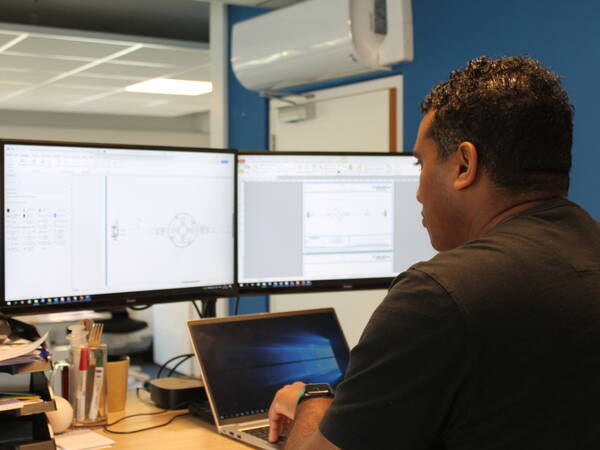
That is why I started creating concept drawings myself, so that I can brainstorm with clients early in the process about their specific wishes and application. This makes the conversation much more concrete: the visual representation makes it clearer more quickly whether all connections have been included, dimensions are correct, and the assembly aligns well with the process in practice. By bringing this step forward, you avoid a lot of back-and-forth later on and can work faster towards a design that is both technically and practically sound.
Safety starts with a good understanding of the process
For me, a good design process always begins with carefully eliciting requirements. Which fluid is being processed and under what pressure and flow conditions? Which equipment is used for coupling, and what functional requirements apply to the various parts of the assembly?
After all, an assembly that looks good on paper is not automatically suitable for practical use. The combination of tubing, connectors, filters, bags, and any measuring components must not only be technically sound but also logically align with the process step for which the assembly is intended. Deviations in pressure, flow, chemical compatibility, or viscosity can have a direct impact on process safety and product quality. It is precisely during the concept phase that I can take a close look at this together with the client. This helps to identify risks early and prevents important details from only surfacing later in the process.
An example of this is that the clamps were forgotten during an initial request for a single-use assembly. This seems like a minor detail, but in a controlled biopharmaceutical environment, it can cause critical risks, such as loss of flow control, contamination, and product loss during disconnections. We were able to correct this during the concept phase, ensuring these risks were resolved in a timely manner.
When designing the assembly, I look not only at functionality but also at user safety, the probability of errors during installation, and whether the chosen configuration is workable in practice. Minimizing installation errors is essential, as these can lead to contamination risks or loss of sterility. The clearer the picture at the outset, the greater the chance that an assembly can be put into use later without unnecessary modifications.
Material, handling, and packaging of the assembly depend on the application
The handling method for single-use assemblies is an important consideration, but it is also a subject that requires precision. Important factors and requirements of the intended application—whether it is an aseptic process, cleanliness requirements, and permissible bioburden—determine the appropriate handling of the assembly. For every application, we assess together with the client which treatment—gamma irradiation, sterilization, or autoclaving—is necessary and whether the chosen assembly materials can undergo this treatment method.
Therefore, during the design phase, I look not only at the functional properties of materials but also at whether they fit the process conditions and requirements of the application. After all, not every material type or component is suitable for every sterilization method or application, and incorrect material choices can lead to risks such as contamination or degradation of the product.
In addition, the packaging method deserves attention already during the design phase. In some situations, an assembly must be packaged in a specific way to align well with the logistical route within a production site. Consider, for example, applications where multiple packaging layers are required for controlled transfer to a clean or sterile environment, without breaking the sterile barrier. Or an assembly that is packaged in an autoclavable bag because it is on the production plant must be able to be autoclaved. By thinking about this early on, you prevent the assembly from failing to comply with cleanroom procedures or aseptic transfers, which results in contamination risks.
Efficiency and ease of use arise from early brainstorming and identifying issues
A well-designed assembly contributes not only to safety and sterility but also to a more efficient process. This efficiency lies primarily in the early detection of errors. In practice, I often see that customers can only truly respond to an assembly proposal once the design has been visualized. Because I design the concept drawing myself, you do not have to go through multiple formal steps before it becomes clear exactly which specifications are required.
It then turns out, for example, that the tubing length or size needs to be different, that a coupling is missing, or that a certain configuration is less logical in practice than initially thought. By identifying these crucial adjustments earlier in the process, we prevent time-consuming modifications later in the process or even in the customer's production environment, where the impact is significantly greater in terms of downtime, costs, and batch loss. The result is a concept drawing that aligns with real-world practice, minimizing the risk of inefficient operations and human error. To me, that is precisely the added value of this method: it saves time in the design phase and ensures that the single-use assembly can be installed as quickly and easily as possible.
From concept drawing to technical design
As soon as the concept drawing is accurate in terms of content, it is sent to our partner UltraPure International. There, the design is reviewed again by the solution design department. This second technical review is valuable because it examines not only the technical operation of the assembly but also its manufacturability and reproducibility.
Where necessary, changes or optimizations are implemented in the design during this phase. Examples include details in the structure, practical considerations for production, or points that need to be defined more precisely in the final working drawing. This combination of early customer contact on our end and the final technical review at UltraPure International helps to arrive at a design that not only aligns well with the application but can also be produced reproducibly and consistently.
Once the technical design and quotation have been approved, the assembly can be put into production. Documentation is also an important part of this process, as full traceability and demonstrable (GMP) compliance are essential for validation and audits. A Certificate of Conformity (CoC) is supplied as standard for the complete assembly. If a sterility claim is required, the assembly is sterilized according to ISO 11137, with a sterility assurance level (SAL) of 10-6. Depending on the application or customer requirements, additional documents may also be made available, such as component-related documentation or product-specific declarations.
For me, the strength of a good design process lies in the combination of early input and technical precision, ensuring that you encounter as few deviations or unexpected problems as possible later in the process. A well-designed single-use assembly prevents critical errors, is quick and easy to install, and ensures that you meet the stringent requirements within your (bio)pharmaceutical application. By taking safety, sterility, and efficiency into account from the very first design, you prevent critical problems from becoming apparent late in the process.
Would you like to brainstorm about a new single-use assembly or optimize an existing design? I would be happy to think along with you